STYLE GUIDES
How to Build a Golf Capsule Wardrobe in 10 Pieces
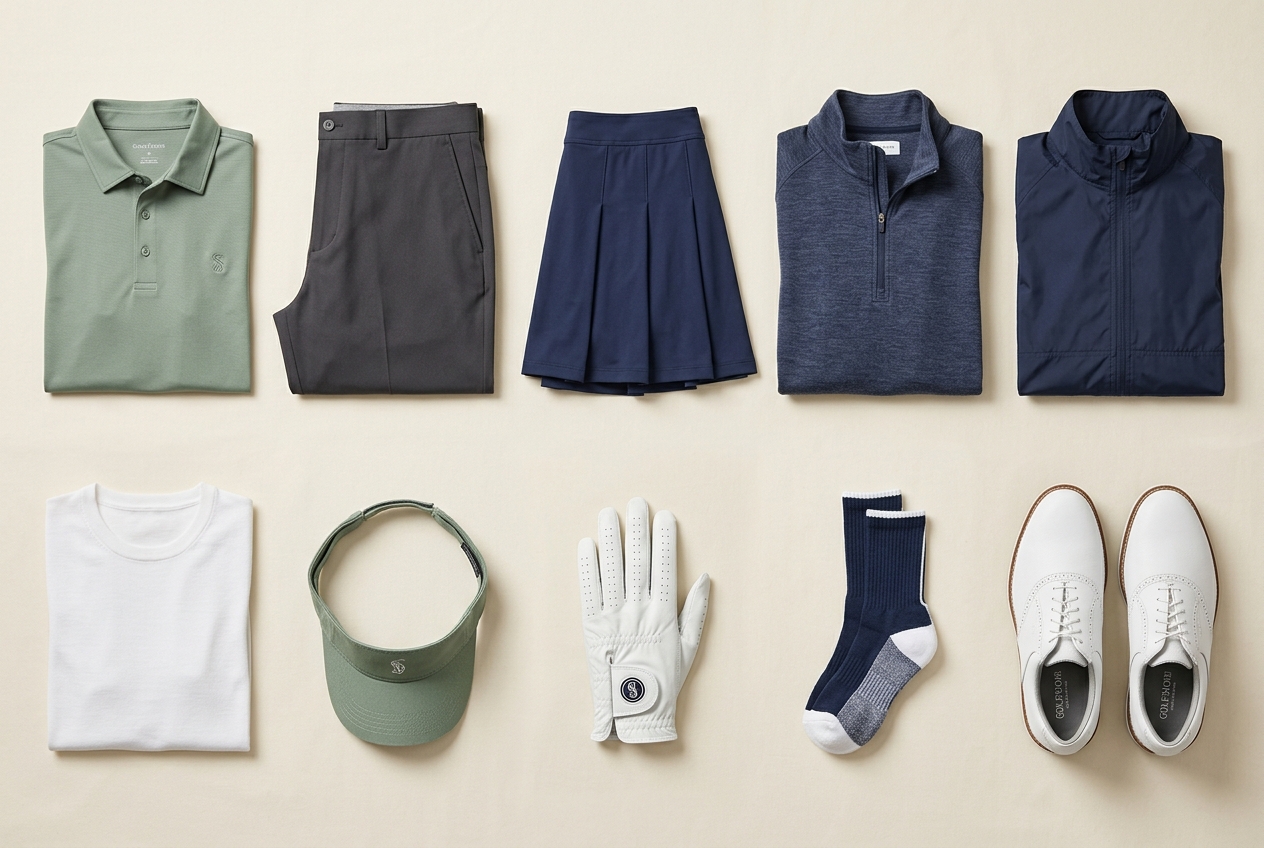
Most golfers own too many clothes and still have nothing to wear. The capsule wardrobe philosophy solves this: ten carefully chosen pieces that mix and match across every situation, every season, and every course type. Here's exactly which 10 pieces to buy, what to look for at each price tier, and how to make them last.
Why a Capsule Approach Works for Golf
Golf dress codes are unusually codified compared to other sports. This means a small set of the right pieces genuinely covers everything — whereas buying randomly leads to redundant polos, shorts that don't fit the occasion, and jackets that can't survive rain. The capsule approach forces better buying decisions: you invest where quality matters most (shoes, outerwear) and spend carefully where volume helps (polos, socks).
The ten pieces below are sequenced from foundational to finishing. Buy in order and you'll always be appropriately dressed with whatever you currently own. By piece ten, you'll have a complete wardrobe that works for public courses, semi-private clubs, and most private club occasions.
The 10 Essential Pieces
1. Three Quality Polos in Neutral Colors
The polo is the single piece doing the most work in your golf wardrobe. You need three — not one, not six — in colors that pair with everything: navy, white, and either sage green or light grey. These three neutrals will coordinate with every bottom you own and never look wrong at any course type.
What to look for: moisture-wicking performance fabric (polyester-spandex blend), 7–8% stretch minimum, collar that holds its shape after washing, and a length that tucks cleanly. Avoid novelty prints or large logos for your core three — they limit coordination options.
Budget ($30–$60): Nike Dri-FIT ADV, Puma MATTR Cloudspun. Both use genuine performance fabric and come in reliable neutral colorways. Mid ($65–$95): Peter Millar Lava Wash Polo offers a softer hand feel and a classic silhouette that reads correctly at private clubs. Premium ($100–$150): Peter Millar's Crown Sport collection — the gold standard for private club golf.
2. Two Pairs of Golf Shorts
Golf shorts deserve specific construction. The 7–9 inch inseam (typically called "Bermuda" or "mid-length") is accepted everywhere from public courses to most private clubs. Cargo pockets disqualify you at virtually every club with a dress code, so avoid them entirely.
Buy one in khaki and one in charcoal or navy — these pair with all three of your polos and look intentional rather than accidental. Stretch fabric (at least 4-way) is non-negotiable for the golf swing.
Budget ($45–$65): Adidas Ultimate365, Under Armour Drive. Mid ($70–$90): TravisMathew Biscayne — excellent stretch, consistent sizing. Premium ($95–$130): Bonobos Golf or Greyson — tailored silhouette that photographs well and holds its shape over time.
3. One Pair of Golf Trousers
Trousers serve a different purpose than shorts: they carry you through cooler months, formal occasions, business golf, and any private club that restricts shorts. One pair of well-fitting golf trousers in charcoal or khaki is all you need for the capsule — they're the most versatile piece in the wardrobe.
Key specs: 4-way stretch fabric, clean flat front, no cargo pockets, and a rise that sits comfortably when you're in a full swing. Performance fabric (not cotton chino) is important — you'll be moving, sweating, and sitting on a cart all day.
Budget ($50–$70): Amazon Essentials Golf Pant (genuinely decent construction). Mid ($75–$100): Adidas Ultimate365 Tapered Pant. Premium ($110–$150): Greyson Wolf Pant — the fit and fabric quality justify the price for regular golfers.
4. One Lightweight Golf Pullover
The pullover (also called a midlayer, sweater, or quarter-zip) handles the 55–70°F temperature range that describes most of the golf season in temperate climates. It goes on in the early morning, comes off by the back nine, and lives in your bag for the rest of the year. This is where you can introduce a subtle color — a heathered green or burgundy pullover adds visual interest without breaking coordination.
Budget ($50–$70): Callaway Swing Tech Quarter-Zip. Mid ($80–$110): Peter Millar Perth Quarter-Zip — excellent warmth-to-weight ratio. Premium ($120–$180): Greyson or Holderness & Bourne — they'll outlast five cheaper midlayers.
5. One Waterproof/Windproof Jacket
A golf jacket that actually keeps rain out is a significant purchase, but it's the one piece where skimping is genuinely punished. Cheap rain suits leak at the seams, stiffen your swing, and lose their waterproofing after two seasons. DWR (Durable Water Repellency) finish matters — look for Gore-Tex or proprietary equivalents.
The jacket should be fitted enough to swing freely without ballooning, and quiet enough not to distract (rustling during your backswing is a real issue with cheap shell fabrics). A lighter color (white, light grey, pale blue) shows cleanliness and reads as intentional rather than emergency gear.
Budget ($80–$120): Nike Golf Repel Jacket — reliable DWR, quiet fabric. Mid ($130–$180): FootJoy DryJoys Rain Jacket. Premium ($200–$350): Galvin Green GORE-TEX — genuinely tour-caliber waterproofing. Worth every dollar if you play in wet climates.
6. One Pair of Spikeless Golf Shoes
Spikeless golf shoes are the first pair most golfers should own. They're comfortable enough to wear off-course, accepted at virtually every venue, and provide more than adequate traction on well-maintained fairways and greens. They're also more forgiving in terms of appearance — they look like a smart casual shoe from a distance, which helps at venues with conservative dress codes.
Budget ($80–$110): Skechers GO GOLF — genuinely comfortable, excellent value. Mid ($120–$160): adidas CodeChaos 22 or FootJoy Contour Casual. Premium ($170–$220): G/FORE Gallivanter — the best-looking spikeless shoe in golf.
7. One Pair of Spiked Golf Shoes
Your second pair of shoes covers wet conditions, hilly courses, and courses where traction is genuinely needed. Soft spikes provide meaningfully better grip in morning dew or after rain, and they're required or strongly preferred at many serious golf clubs. Buy these in a classic color — brown leather or white — that won't date.
Budget ($80–$110): Nike Air Zoom Infinity Tour. Mid ($130–$160): FootJoy Pro SL or adidas Tour360. Premium ($200–$280): FootJoy Tour Alpha — worn by more tour professionals than any other shoe.
8. One Golf Belt
The belt is a finishing piece that separates the assembled look from the pulled-together look. At private clubs, tucked-in polos with a proper belt are the norm. A reversible belt (tan/brown or black/brown) gives you two colorways in one purchase. Leather or high-quality PU — never fabric or canvas for club rounds.
Budget ($25–$35): Amazon basics leather reversible belt — genuinely fine. Mid ($45–$65): Callaway or Cobra leather dress belt. Premium ($80–$120): G/FORE leather belt — elevated hardware and construction that lasts a decade.
9. Two Pairs of Golf-Specific Socks
Golf socks sound trivial until you've walked 18 holes in cushioned moisture-wicking socks versus regular athletic socks. Golf-specific socks have extra cushioning in the heel and ball of foot, arch compression, and moisture management built for the specific demands of walking a course in leather footwear. Buy two pairs — one for each shoe.
Budget ($10–$15/pair): Darn Tough or Bombas golf-length socks. Mid ($18–$25/pair): FootJoy ProDry Lightweight — the standard most club golfers reach for. Premium ($30–$40/pair): Swiftwick Pursuit Golf — tour-standard compression and durability.
10. One Golf Hat or Visor
Complete the look and protect yourself from sun exposure. A structured golf hat in neutral color (navy, white, black, or natural tan) coordinates with the rest of the capsule and stays appropriate everywhere. Logos are fine — but keep them understated. The structured performance cap (not a snapback or baseball cap) is the universal accepted style.
Budget ($20–$30): Nike Golf Aerobill Classic99. Mid ($35–$50): Titleist Tour Performance Hat. Premium ($55–$80): Imperial golf caps — built with premium materials and tailored fit options.
Building the Capsule: A Phased Approach
You don't need to buy all ten pieces at once. Here's a phased approach that ensures you're always appropriately dressed regardless of where you are in the build:
Phase 1 — The Essentials (Pieces 1, 2, 6): Three polos, two pairs of shorts, and spikeless shoes. This covers public courses and most semi-private venues in warm weather. Total investment: $300–$600 depending on tier.
Phase 2 — Club Ready (Add Pieces 3, 4, 8): Add trousers, a pullover, and a belt. Now you can play anywhere that doesn't require spiked shoes, in any weather above 45°F. Total added: $200–$400.
Phase 3 — Complete (Add Pieces 5, 7, 9, 10): Waterproof jacket, spiked shoes, two pairs of socks, and a hat. You're fully equipped for any course, any weather, any occasion. Total added: $300–$600.
The beauty of the capsule approach is that each piece earns its place. You use everything you own, and every combination looks intentional.
INTERACTIVE TOOL
Use our Golf Outfit Builder to visualize how your capsule pieces mix and match — see complete outfit combinations before you buy.
Try the Outfit Builder →Capsule Wardrobe Care Basics
The capsule approach only works if your pieces remain in excellent condition. Performance golf fabrics require specific care that differs from regular laundry. For comprehensive fabric-by-fabric guidance, see our complete golf clothing care guide. The key principles:
Performance polos and shorts: Cold wash, gentle cycle, hang dry. Never use fabric softener — it coats the moisture-wicking fibres and permanently reduces their effectiveness. Turn inside out to protect the outer surface and any logos.
Waterproof jackets: Follow label instructions precisely. Re-proof with DWR spray or tumble dry on low every 10–15 washes to restore waterproofing. Never use standard detergent — use a technical wash like Nikwax Tech Wash.
Golf shoes: Remove and clean after every round. Use shoe trees in leather styles to maintain shape. Re-waterproof leather shoes seasonally with a conditioning treatment.
Brands like Peter Millar and TravisMathew both provide detailed fabric care instructions with their garments — read them before the first wash and your pieces will last years, not seasons.
Frequently Asked Questions
Do I really need two pairs of shoes in the capsule?
For most golfers who play 20+ rounds per year across different course types, yes. Spikeless shoes are your everyday workhorses, but spiked shoes provide meaningfully better traction in wet conditions and are required at some private clubs. If you play exclusively on dry public courses, one pair of quality spikeless shoes is sufficient to start.
Can I build a capsule for under $500?
Yes, focusing on budget tier picks across all ten pieces lands you roughly in the $350–$550 range. Prioritize shoes and the waterproof jacket at mid-tier (these have more direct performance implications), and stay budget on the belt, socks, and hat. Three budget-tier Nike or Puma polos, two pairs of Adidas shorts, and a pair of Skechers spikeless shoes gets you a functional Phase 1 wardrobe for around $250.
Should I use the Outfit Builder tool to plan my capsule?
Yes — the Golf Outfit Builder is specifically designed for this use case. Input the pieces you're considering and see which combinations work best before you buy. It's particularly useful for confirming that your three polos, two pairs of shorts, and trousers all coordinate with each other rather than only looking good in isolation.
GolfClothing.com is reader-supported. When you buy through links on our site, we may earn an affiliate commission at no extra cost to you. Learn more →
Get the Golf Capsule Wardrobe Checklist
A printable checklist of all 10 pieces with brand recommendations at every price tier.
Free. No spam. Unsubscribe anytime.