MEN'S GOLF JACKETS
Best Golf Jackets 2026: Waterproof, Wind-Resistant & Performance Picks
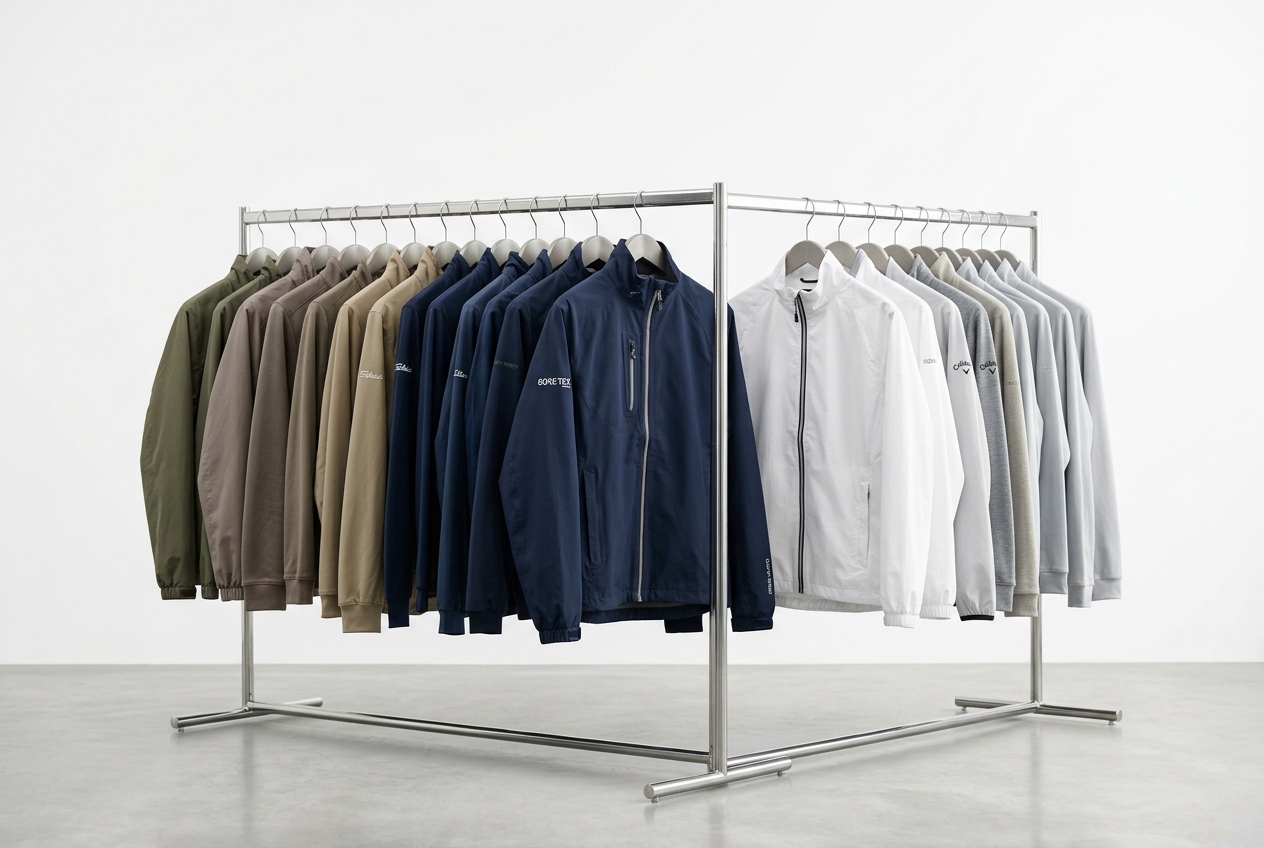
A golf jacket sits at an awkward intersection of demands: it must let you swing freely, keep rain off your shirt, compress into a pocket-sized package for your bag, and still look respectable when you walk into the clubhouse afterward. Most jackets handle two or three of these requirements adequately. The best handle all four without apology. After testing nine jackets across wet British-style links conditions and calm inland courses, here is what we found actually works.
The 9 Best Golf Jackets
1. Galvin Green Armstrong Waterproof Jacket
Galvin Green is the brand that professional tour caddies and serious amateur golfers reach for when conditions turn genuinely foul — not mildly overcast, but the sustained horizontal rain that only links golf can produce. The Armstrong Waterproof is the flagship expression of that commitment. It uses GORE-TEX construction with a 3-layer laminate that delivers a 28,000mm hydrostatic head rating — well beyond the 10,000mm threshold needed for serious waterproofing and more than double what many "waterproof" golf jackets actually provide.
What sets the Armstrong apart beyond its headline waterproofing is the seam construction. The jacket uses fully taped seams throughout — not just the critical shoulder and chest seams, but the cuffs, hem, and zipper baffles as well. This matters in the real world because most rain jacket failures over time happen at seams, particularly at the cuffs where the jacket makes constant contact with your grip and glove. Galvin Green's seam tape is rated to last the lifetime of the jacket with proper care.
The swing construction is worth examining closely. Galvin Green engineers the Armstrong with a pivoting back panel — a section of fabric that moves independently of the body shell to allow unrestricted rotation through the backswing and follow-through. The back venting system uses a concealed waterproof zipper that allows airflow during warmer wet conditions without compromising the waterproof barrier. At 340 grams packed, it compresses to approximately the size of a water bottle, fitting easily in the outer pocket of a standard carry bag.
The Armstrong is not a casual purchase. At $280 to $340 it costs roughly double what a competent mid-range rain jacket costs. But for golfers who play through autumn and winter in regions where genuine sustained rain is a regular feature of the round — not an occasional afternoon shower — the Armstrong's performance justifies the cost decisively. It is the jacket you buy once and use for years, not the jacket you replace when the waterproofing degrades after two seasons.
Pros
- 28,000mm hydrostatic head rating — genuinely waterproof
- Fully taped seams including cuffs
- Pivoting back panel for swing freedom
- Compresses to water-bottle size
- Lifetime seam tape warranty
Cons
- $280–$340 is premium pricing
- Limited colorways compared to fashion brands
- Requires specialist cleaning products to maintain DWR
2. Peter Millar Stealth Performance Hybrid
The Stealth Performance Hybrid occupies a different category than the Galvin Green Armstrong — it is not trying to be the most waterproof jacket on the course. What it tries to be, and largely succeeds at, is the single jacket that a golfer who plays in varied conditions can use for 90% of their rounds. It combines a water-resistant shell (10,000mm rating — more than adequate for light to moderate rain and brief heavy showers) with quilted thermal panels across the chest and back that provide genuine warmth in early morning rounds in the 45-55°F range.
The "hybrid" construction — a technical outer shell combined with quilted inner panels — gives the Stealth a more tailored visual silhouette than a pure rain jacket. This matters because it transitions from course to restaurant or bar without looking like you forgot to change out of your wet weather gear. Peter Millar has deliberately engineered the collar, hem length, and zip pull details to read as an elevated casual jacket rather than technical outerwear. For golfers who often go directly from the 18th green to dinner, this is a meaningful practical advantage.
Performance in play is excellent. The stretch woven shell fabric (90% polyester, 10% spandex) moves with the swing without the stiffness that affects many water-resistant jackets. Peter Millar cut the armhole higher and tighter than most golf jackets, which sounds counterintuitive but actually gives better swing feel because the sleeve doesn't bunch in the armpit at the top of the backswing. The jacket compresses into its own chest pocket — a more elegant solution than requiring a separate stuff sack.
One honest limitation: the Stealth is not the jacket for a four-hour round in sustained heavy rain. That's where the Galvin Green Armstrong earns its price. But for the golfer who encounters three inches of rain in a round once or twice a season and otherwise faces wind, morning chill, and occasional light showers, the Stealth's versatility makes it the stronger everyday choice.
Pros
- Versatile hybrid construction for 3-season use
- Compresses into its own pocket
- Tailored silhouette transitions off-course
- High armhole cut improves swing feel
- Excellent construction quality at this price
Cons
- 10,000mm rating inadequate for sustained heavy rain
- Quilted panels add bulk in warm weather
- Premium price may not suit occasional golfers
3. Nike Storm-FIT ADV Jacket
Nike's Storm-FIT ADV designation indicates their highest level of waterproof-breathable construction — above the basic Storm-FIT level and equivalent to what competitors call premium waterproofing. The rating sits at 15,000mm hydrostatic head rating with a breathability index of 20,000g/m2/24h, which positions it between the Galvin Green's extreme waterproofing and the Peter Millar's lighter water-resistance. For most golfers, 15,000mm is more than adequate for realistic on-course rain conditions.
The ADV construction uses a 4-way stretch woven face fabric that feels noticeably different from the crinkle-texture feel of most technical waterproof jackets. It drapes and moves more like a performance mid-layer than a rain shell, which makes it more comfortable to wear for the full round rather than just the wet portions. Nike positions this jacket as something you'd leave on throughout a round rather than stuffing in the bag between showers — and the fabric construction supports that use case.
Nike's swing engineering in the ADV uses articulated seam placement and raglan sleeve construction to allow the arms to move forward and overhead without the back riding up — a common failure mode in jackets that prioritize visual silhouette over athletic range of motion. The result is a jacket that a golfer forgets they're wearing during the swing, which is precisely the right outcome. Storm-FIT ADV is also available in women's sizing with adjusted patterning, making it one of the few premium technical golf jackets with genuine women's construction rather than a scaled-down men's version.
Pros
- 15,000mm rating handles most real-world rain
- 4-way stretch woven face fabric moves naturally
- Raglan sleeve construction for swing freedom
- Available in genuine women's sizing
- Strong value at the premium-mid price point
Cons
- Colorways skew sportswear rather than traditional
- Less packable than Peter Millar's chest-pocket compression
- DWR treatment requires periodic re-application
4. J.Lindeberg Ash Light Jacket
J.Lindeberg comes at golf outerwear from the fashion end of the spectrum — the brand was founded by a former fashion executive with a deliberate intent to bring Scandinavian menswear design sensibility to performance golf apparel. The Ash Light Jacket reflects that philosophy: a wind-resistant, water-repellent shell that prioritizes silhouette and visual refinement alongside performance. It is the jacket you wear when you want to look like you've considered your outfit rather than just grabbed the nearest waterproof layer.
The Ash's construction uses a bonded polyester-elastane face fabric with a durable water repellent finish — not a full waterproof membrane. The practical threshold here is meaningful: the Ash will handle a 20-minute shower without soaking through, but it is not designed for sustained heavy rain. Think of it as wind and light rain protection with style dividends, not as a replacement for a full waterproof jacket in serious conditions. For golfers who play primarily in climates where the rain is brief and the wind is the real adversary, this is a perfectly reasonable trade-off.
Where the Ash earns its price is the construction quality and fit engineering. The slim, tapered silhouette fits cleanly over a polo without looking like a sack, and the minimal branding (a small J.Lindeberg logo at the chest) makes it appropriate for traditional clubs that prefer understated apparel. The zip pocket system keeps valuables secure without adding visual bulk. The Ash is a jacket that will draw compliments in the pro shop and look appropriate at dinner — the functional performance is good, but the design quality is the primary reason to buy it.
Pros
- Exceptional Scandinavian design quality
- Slim silhouette works on and off course
- Minimal branding suits traditional clubs
- Wind resistance is excellent
- Bonded construction reduces bulk
Cons
- Not waterproof — only water-repellent
- Slim fit may not suit all body types
- Premium pricing for a wind layer
5. FootJoy HydroLite Rain Jacket
FootJoy's HydroLite is the dedicated rain jacket benchmark at the value tier — the jacket that has outfitted more amateur golfers during wet rounds than probably any other single product. Its strength is honest performance at a defensible price: a 10,000mm hydrostatic head rating that handles genuine rain (not just mist), fully taped seams at the most critical water-entry points, and a consistent construction that improves on the limitations of cheaper rain gear without approaching the premium of Galvin Green or Peter Millar.
FootJoy designs the HydroLite as a purpose-specific rain jacket — it does not try to be a lifestyle piece or transition seamlessly into dinner afterward. This focused purpose allows them to optimize the construction for its actual job: keeping rain off your shirt while you finish the round. The fit is intentionally slightly roomier than fashion-forward jackets, which accommodates the range of motion better and allows layering underneath without the jacket binding across the back during the swing.
At 280 grams, the HydroLite is one of the lighter options in its class. It compresses into a small stuff pocket (included) and fits easily in an outer bag pocket or the small compartment of a carry bag. For golfers who want reliable rain protection without spending $250 or more, the HydroLite is the clear recommendation. Buy this and spend the savings on a round at a course you've been meaning to play.
Pros
- Strong 10,000mm waterproof performance for the price
- Lightweight at 280g with stuff sack included
- Fit allows layering underneath
- FootJoy's track record for on-course reliability
Cons
- Not designed for off-course wear
- Roomy fit won't suit golfers who prefer tailored silhouettes
- Limited colorways — function over form
6. TravisMathew Interlude Jacket
TravisMathew built its brand identity around the idea that golf clothing should look like clothing you'd actually want to wear all day — not a uniform you put on reluctantly before teeing off and change out of immediately afterward. The Interlude Jacket applies this philosophy to outerwear. It is a water-resistant mid-layer that functions on the course during mild wet conditions and looks genuinely good in any casual setting afterward: brunch, a bar, running errands. The design language is relaxed California menswear, not technical sportswear.
The construction uses a 4-way stretch woven shell with a durable water repellent finish — similar to the J.Lindeberg Ash but at a notably more accessible price point. The fit is relaxed through the shoulders and chest with a slight taper through the body, hitting the right balance between comfort and intention. TravisMathew uses a stand collar construction that works with or without a mid-layer underneath, and the two exterior zip pockets are sized for a modern phone without looking stretched.
For the golfer who plays in mild conditions — morning rounds in cool weather, occasional light rain, post-golf activities in the same clothes — the Interlude is the most versatile mid-range choice here. Its limitation is the same as the J.Lindeberg Ash: it is not waterproof in any meaningful sense, and sustained rain will eventually soak through. Know what you're buying: a style-forward water-resistant layer, not a dedicated rain jacket.
Pros
- Best off-course aesthetics in this price range
- 4-way stretch moves well through the swing
- Stand collar works with multiple layering options
- Excellent value for a versatile mid-layer
Cons
- Water-resistant only — not waterproof
- Not appropriate for sustained heavy rain
- Relaxed fit may not suit more formal clubs
7. Under Armour Storm ColdGear Jacket
The Under Armour Storm ColdGear occupies a different niche than the other jackets here — it is primarily a thermal layer for cold conditions rather than a rain jacket with some warmth. The ColdGear insulation technology uses a brushed inner face that traps body heat effectively in the 35-50°F range, while the UA Storm outer shell treatment repels light moisture. For golfers who play in genuinely cold conditions — early season, late season, or northern climates where the temperature rarely breaks 50°F during the round — this thermal focus is exactly right.
The construction uses 4-way stretch fabric throughout, which Under Armour applies consistently well across their golf line. The swing feel is clean and unrestricted, partly because ColdGear construction is inherently athletic in its orientation. The fit runs slightly athletic — snug through the chest and shoulders, tapered through the torso — which aids freedom of movement and thermal efficiency at the cost of a bit of visual roominess. Under Armour's storm technology does repel light rain and morning dew reliably, though it will eventually soak through in sustained downpours.
At $120 to $150, the ColdGear is the most accessible price point in this guide for a jacket that handles genuine cold. The thermal performance per dollar is strong. If your primary challenge is cold mornings rather than rain, this is the right tool. If you need rain protection first and warmth second, look up the list toward the FootJoy HydroLite or Galvin Green Armstrong.
Pros
- Excellent thermal performance for cold-weather rounds
- 4-way stretch for unrestricted swing
- Strong value at this price for cold conditions
- Light moisture repellency for damp mornings
Cons
- Not waterproof — thermal focus, not rain protection
- Athletic fit may restrict layering over bulkier mid-layers
- Too warm for rounds above 60°F
8. Callaway Corporate Waterproof Jacket
The Callaway Corporate Waterproof exists for a specific purpose: the corporate golf outing where the company logo will be embroidered on the left chest and the jacket will be worn by a mixed group of golfers with varying skill levels and body types in whatever weather the day produces. Callaway has designed this jacket to handle embroidery well (reinforced chest panel that doesn't distort under needle work), fit a range of body proportions without requiring precise sizing (slightly generous cut throughout), and provide reliable 10,000mm waterproofing that will protect everyone from a moderate rain shower.
The swing construction is solid without being exceptional — adequate for most golfers at a corporate outing, though a scratch golfer with a fast swing may notice some restriction through the back at full extension. The visual design is deliberately conservative: clean lines, minimal performance branding, a color palette that leans toward navy, charcoal, and black rather than bright performance colors. This conservatism is appropriate for its intended context and actually makes the jacket work well for traditional club play as well.
Callaway makes this jacket available through corporate sales channels in addition to retail, with volume pricing that makes it more attractive for company purchases of 12 or more. For individual purchases, it's a reasonable mid-tier waterproof jacket with a slightly generic aesthetic. For its intended corporate context, it's very well-executed.
Pros
- Embroidery-ready chest panel construction
- Generous fit accommodates mixed groups
- Conservative styling works at traditional clubs
- Reliable 10,000mm waterproofing
Cons
- Generic aesthetic for individual purchase
- Swing construction adequate rather than excellent
- Generous cut doesn't flatter all body types
9. Adidas Rain.Rdy Full Zip Jacket
The Adidas Rain.Rdy is the entry-level waterproof jacket recommendation for golfers who need genuine waterproofing on a strict budget. The Rain.Rdy designation indicates Adidas's proprietary waterproof-breathable technology — not GORE-TEX, and not at the performance ceiling of Galvin Green, but legitimately waterproof in a way that protects through a typical afternoon shower. The face fabric uses Adidas's PRIMEGREEN recycled material, which is a genuine sustainability commitment rather than a marketing afterthought — the jacket contains at least 50% recycled content throughout.
The construction is simpler than the premium options: critical seams are taped but not all seams, the stretch fabric is functional rather than exceptional, and the swing feel is adequate for recreational play. Golfers with faster swings or higher expectations for range of motion will notice the comparative limitation versus the Galvin Green or Peter Millar. For recreational golfers who play less than once a week and want reliable rain protection without paying $200 or more, the Rain.Rdy performs its function honestly.
The three-stripe branding is visible and the colorways lean athletic. This is not a jacket for traditional clubs with conservative dress codes, and it won't pass for casual apparel in most restaurant settings. Buy it for what it is: competent, affordable waterproofing in a package that keeps you dry on the course, full stop.
Pros
- Most affordable genuine waterproof jacket here
- PRIMEGREEN recycled content — genuine sustainability
- Critical seam taping protects key water-entry points
- Wide availability in retail and online
Cons
- Visible three-stripe branding isn't universally appropriate
- Swing feel limited compared to premium options
- Not all seams taped — some risk at less critical points
Waterproof Ratings: What the Numbers Mean on the Course
The hydrostatic head rating is the primary waterproof benchmark in technical outerwear — it measures how many millimeters of water pressure a fabric can withstand before water begins to penetrate. A 1,500mm rating handles light rain briefly. A 5,000mm rating handles moderate rain for a typical round. A 10,000mm rating handles sustained rain in most real-world conditions. A 28,000mm rating, like the Galvin Green Armstrong's, handles sustained Scottish links weather.
The distinction between "waterproof" and "water-resistant" matters considerably in practice. Water-resistant fabrics have a durable water repellent (DWR) coating that causes rain to bead and roll off the fabric surface. This works beautifully in light rain and brief showers. But DWR treatments degrade over time with washing and use, and when wet-out (when the face fabric absorbs water and no longer beads), even a technically waterproof membrane underneath performs poorly because the saturated face fabric acts as a conductor rather than a barrier.
The waterproof membrane is what keeps water out even after the DWR has failed. GORE-TEX is the most recognized membrane brand, used by Galvin Green. Nike uses their proprietary Storm-FIT ADV membrane. Other brands use various third-party membranes. The membrane rating is the number that matters for sustained rain conditions. Seam construction is the other critical variable: even a 28,000mm fabric fails at the seams if those seams aren't taped with waterproof tape. Always look for "fully taped seams" on serious rain jackets — critical seam taping only (shoulder and center back) leaves the cuffs and side seams vulnerable.
Breathability ratings — expressed in grams of moisture vapor transmitted per square meter per 24 hours (g/m2/24h) — matter because a non-breathable waterproof jacket becomes uncomfortable during exercise. You stay dry from rain but soak from sweat. A 10,000g/m2/24h breathability rating handles recreational golf. Above 20,000g/m2/24h provides genuinely comfortable breathability during the walking exertion of a full round.
Packability and Weight: Fitting in Your Golf Bag
A golf jacket's utility is determined in part by whether you actually have it with you when the weather changes. Golfers who play early mornings or in variable-weather regions know the particular misery of arriving at the course with the right jacket packed — and discovering they've left it at home because it takes up too much space in the bag. Packability is not a luxury feature; it is a direct function of whether the jacket earns its place in your regular bag.
The benchmark for an easily packable golf jacket is fitting into a stuff sack about the size of a large water bottle — a volume that fits into an outer pocket of virtually any golf bag. Jackets in the 250-350 gram range meet this threshold. Jackets above 400 grams typically require their own dedicated bag space and become items you decide whether to pack rather than items that are always there.
Jacket construction determines packability more than any other variable. 3-layer laminate constructions, where the waterproof membrane is bonded between the face fabric and a lining, tend to pack smaller than 2.5-layer constructions that have a loose inner lining. Quilted insulation, like the Peter Millar Stealth's chest panels, add warmth but also add compression resistance — the jacket doesn't pack quite as small as a pure shell. Dedicated rain jackets without insulation are generally the most packable; hybrid jackets with insulation are less so.
The stuff-sack question: some jackets include a dedicated stuff sack (FootJoy HydroLite), some pack into their own pocket (Peter Millar Stealth), and some require you to fold and compress into whatever available bag space you have (Adidas Rain.Rdy). Packing into the jacket's own pocket is the most elegant solution — one fewer accessory to track, and the compressed jacket is always neat and ready.
Swing Freedom: Armhole Construction and Stretch Panels
A golf jacket that restricts your swing is worse than no jacket at all — you'd rather be wet and swinging freely than dry and forced to abbreviate your backswing. Swing freedom in golf outerwear comes from two sources: the armhole and sleeve construction, and the presence or absence of stretch panels in the right locations.
Armhole placement is the most commonly misunderstood variable in golf jacket fit. A low, open armhole — what you find in a casual sportswear jacket — seems like it would provide more swing freedom. In practice, it creates the opposite problem: as your arms move forward and upward, the low armhole catches on the shirt underneath and the entire back of the jacket rides up. A higher, tighter armhole (like Peter Millar engineers into the Stealth) keeps the jacket anchored to your body throughout the swing. The fabric moves with you rather than shifting relative to you.
Raglan sleeve construction — where the sleeve extends to the collar rather than joining at a shoulder seam — eliminates the shoulder seam entirely and allows unrestricted forward arm movement. Nike's Storm-FIT ADV uses raglan construction. The trade-off is a slightly less tailored visual appearance and reduced shoulder structure. For performance golf use, the trade-off is unambiguously worth it.
Stretch panels at the back yoke, under the arms, and across the upper back allow the fabric to expand with the swing rather than resist it. The best implementations use a stretch-woven face fabric throughout (rather than panels sewn into a non-stretch shell), which avoids the visual seaming that stretch panels can create while providing uniform movement. Galvin Green's pivoting back panel is a different engineering solution to the same problem: a section of the back shell that is mechanically free to rotate during the swing.
The practical test: put the jacket on, take a full backswing against a full-length mirror or have someone watch your trail arm at the top of the backswing. If the jacket pulls across the back, rides up significantly, or restricts the arm from reaching its natural position, the jacket will affect your swing. This test takes three minutes and reveals more than any specification sheet.
All 9 Jackets Compared
| Jacket | Price | Waterproof Rating | Weight | Best For | Rating |
|---|---|---|---|---|---|
| Galvin Green Armstrong | $280–$340 | 28,000mm GORE-TEX | ~340g | Maximum waterproofing | 4.9 |
| Peter Millar Stealth | $250–$295 | 10,000mm hybrid | ~380g | Versatile 3-season | 4.9 |
| Nike Storm-FIT ADV | $185–$220 | 15,000mm | ~310g | All-weather performance | 4.7 |
| J.Lindeberg Ash | $195–$245 | DWR only | ~270g | Style + light weather | 4.7 |
| FootJoy HydroLite | $100–$130 | 10,000mm | ~280g | Rain value | 4.6 |
| TravisMathew Interlude | $145–$175 | DWR only | ~290g | Course-to-casual | 4.6 |
| Under Armour ColdGear | $120–$150 | DWR + insulation | ~350g | Cold weather | 4.4 |
| Callaway Corporate | $130–$160 | 10,000mm | ~320g | Corporate events | 4.4 |
| Adidas Rain.Rdy | $110–$140 | Rain.Rdy membrane | ~300g | Budget waterproof | 4.3 |
Frequently Asked Questions
What's the difference between waterproof and water-resistant golf jackets?
Waterproof jackets have a sealed membrane (like GORE-TEX) bonded to the fabric that physically blocks water from penetrating, measured by a hydrostatic head rating of 10,000mm or more. Water-resistant jackets have only a durable water repellent (DWR) coating on the face fabric that causes rain to bead and run off. DWR works well in light rain and short showers but eventually fails — particularly at cuffs and shoulders where abrasion degrades the coating faster. For sustained rain over a full round, you need genuine waterproofing with taped seams, not just DWR treatment.
Do I need a separate rain jacket and wind jacket?
Not necessarily, but the compromise matters. A full waterproof jacket like the Galvin Green Armstrong or FootJoy HydroLite handles both wind and rain but may be heavier and less breathable than a dedicated wind layer. A wind-focused jacket like the J.Lindeberg Ash is lighter and more packable but will eventually soak through in sustained rain. If you play in genuinely variable weather — where the forecast can be wrong in either direction — carrying both a lightweight wind layer and a packable rain jacket gives you the flexibility to respond to actual conditions. For golfers who can make reasonable weather predictions before teeing off, one well-matched jacket is usually sufficient.
What's the best packable golf jacket for travel?
The Peter Millar Stealth Performance Hybrid is the best single packable jacket for travel golf — it compresses into its own chest pocket, handles a wide range of conditions, and looks appropriate at the clubhouse afterward. If you're traveling primarily to warm, sunny destinations and only need occasional rain protection, the J.Lindeberg Ash is smaller and lighter. For destinations with genuinely unpredictable or wet weather (Scotland, Ireland, Pacific Northwest USA), the FootJoy HydroLite is the most honest rain protection at the most travel-friendly price.
How do I know if a golf jacket will restrict my swing?
The most reliable test is physical: put the jacket on and take a full backswing in front of a mirror, or have a playing partner watch your trail arm at the top. If the jacket pulls across your upper back, if the sleeve bunches in your armpit at full extension, or if you naturally abbreviate your swing to avoid the resistance, the jacket will affect your performance. Look for jackets with raglan sleeve construction, a high armhole (counterintuitively better for golf), or a pivoting back panel. If shopping online without trying first, look for explicit "engineered for golf swing" or "articulated sleeve construction" descriptions, and check the return policy before buying.
Are expensive golf jackets worth it?
It depends on what problem you're solving and how frequently you encounter it. For golfers who regularly play in genuine rain — multiple times per season, full rounds through sustained precipitation — the difference between a $100 FootJoy HydroLite and a $300 Galvin Green Armstrong is real and meaningful: better seam construction, more durable membranes, superior breathability, and longer performance life. For golfers who play primarily in fair weather and need a jacket for occasional showers, the FootJoy HydroLite or even the Adidas Rain.Rdy performs its function adequately at half the price. The expensive jackets earn their cost through frequency of hard use, not because cheaper options are dishonest about their performance.
GolfClothing.com is reader-supported. When you buy through links on our site, we may earn an affiliate commission at no extra cost to you. Learn more →
Golf Gear Deals & Reviews
Get curated gear recommendations, seasonal buying guides, and sale alerts from trusted brands.
Free. No spam. Unsubscribe anytime.